Medical Marijuana Card in Montana and Indiana: What Residents Need to Know
A medical marijuana card is issued according to state laws, and each program is unique. Some states maintain registries and offer open online applications; others offer programs only for certain products; and some states have no medical program at all. When one searches for a medical marijuana card, one has to use the state rules rather than the general rules in the country. The following comparison between Montana and Indiana reveals differences in the process. This information is general and not medical or legal.
Montana: State Program
State of Montana has an established state program of medical marijuana cards that is handled by the state revenue department. Residents of Montana can apply to the program using proof of residence in the form of a Montana driver's license, state or tribal identification, voter registration, or hunting and fishing licenses. Among the documents needed for applying to the program, there is a Physician Statement for the debilitating medical conditions that should be signed by the Montana-licensed doctor of medicine (MD) or osteopathy (DO). The statement cannot be older than 60 days.
Applying Through the State Portal
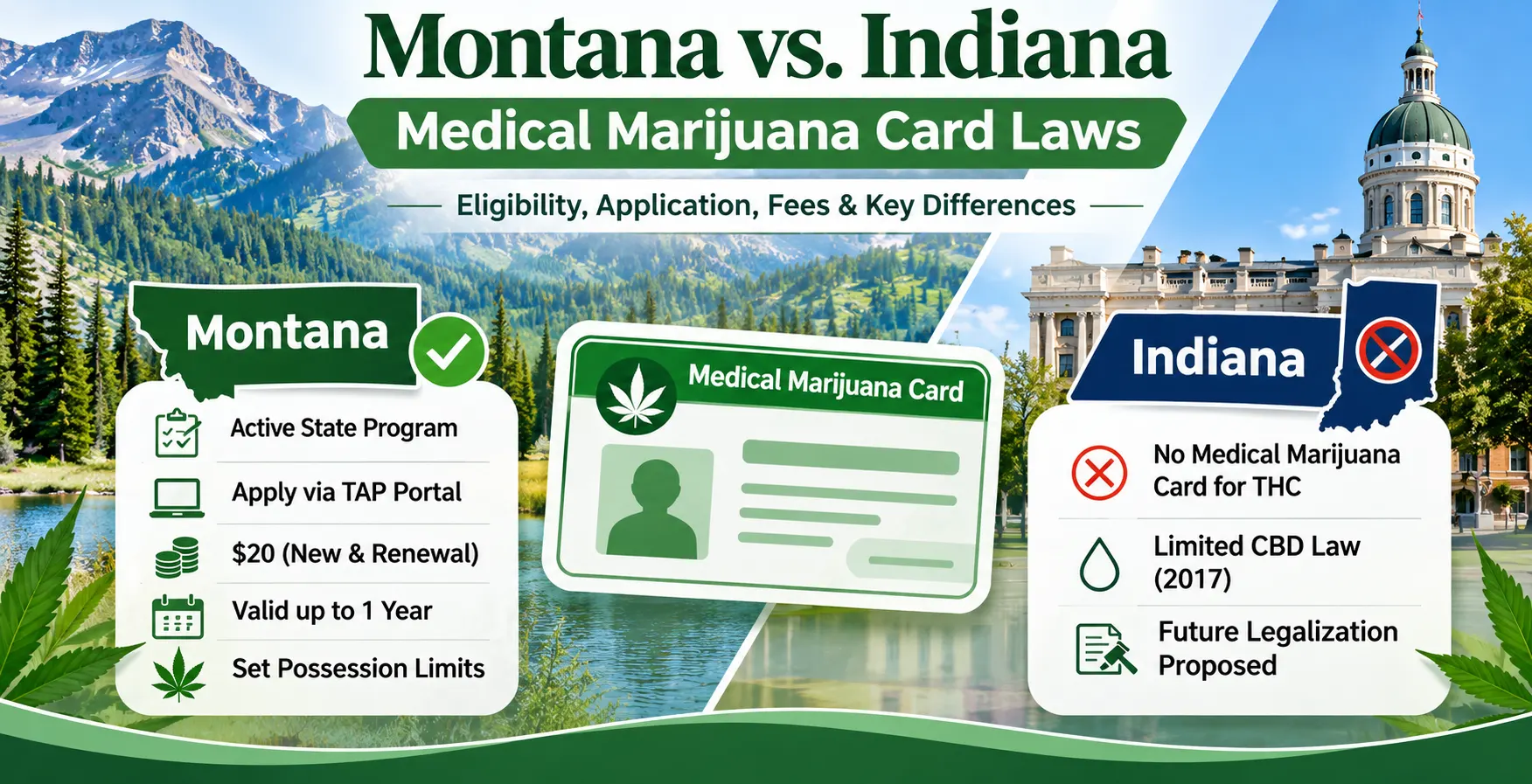
Application in Montana is done via the TransAction Portal, referred to as TAP. Payments can be made online through credit, debit, or ACH payments, or through checks or money orders sent through the mail. One may obtain a temporary medical marijuana card in Montana via the portal if he/she applies for registration and issuance of a new card, but there must always be a physical copy of the card to use. Photos should be taken under certain requirements, such as a plain background and without wearing caps, sunglasses, or facial masks, and must also be recent.
Cost, Validity and Renewal
According to the state website, the non-refundable cost is 20 dollars for both new registration and renewal of registration, while that for replacement of a card is 10 dollars. Cards issued will have a validity of one year or less, depending on the instructions from the physician. The process of renewal will be through the same portal; hence, it would be wise to set a reminder before the expiration of the card. Fees might change; hence, one should confirm the exact costs from the official state website.
Possession Limits and Designated Purchasers
These limitations include the amount of flower permitted to cardholders on daily and monthly bases and the process by which cardholders can request an increase in the amount to eight ounces per month using a signed statement by the treating physician in the Physician Statement. Cardholders may designate no more than two designated purchasers, all aged 21 years or above. A breach of these limitations may attract legal consequences, and therefore cardholders should understand these limitations.
Rules for Minors
Minor applicants under the age of 18 years will be required to take a different approach. The Physician Statement for Minors should be utilized instead of the ordinary Physician Statement. In case the referring or treating physician is not an oncologist, neurologist, or epileptologist, then consent will be needed from two physicians regarding the application. A guardian is also required to provide proof of legal guardianship, such as birth certificates. It is advisable that parents/guardians thoroughly read the instructions provided in Montana, as documentation is a common reason for delay.
Indiana: No Medical Marijuana Card for THC Products
However, Indiana is quite an exception. As of May 2026, Indiana remains one of the very few states that lack a medical cannabis program and a medical marijuana card for THC-based cannabis. Those citizens of Indiana who are interested in getting a medical marijuana card, giving the right to purchase THCA products according to Indiana state laws, will not be able to do it in Indiana. All the websites offering Indiana medical marijuana cards for THC cannabis must not be used, since they are unable to offer it.
Indiana Medical Laws Today
The old Indiana statute, introduced in 2017, made the use of CBD oil with low THC content for epileptic patients legal. This law created a list of patients. It looks like the implementation of the law is quite rare, and there is no detailed description of the program provided. Interested patients should look into the Indiana statutes and the Indiana Department of Health.
Possible Changes Ahead
The laws of Indiana could change in the coming days. The state senator has expressed that he is drafting legislation that will legalize the use of medical marijuana in Indiana and will put regulation in place for its sale, distribution, use, and taxation. The legislation is to be proposed later in the year, and there is nothing in force currently. The federal government is also planning to reschedule marijuana in the country, and it could affect the programs of the states. It is always better to rely on official sources and predictions.
Choosing an Online Provider Wisely
There are many who start their application process online through the means of a telehealth consultation and online forms. It might seem convenient; however, it is essential to make sure that the physician is licensed in your state, the assessment is genuine, and the state recognizes the certificate. It is important not to fall for services that promise acceptance, have extremely high acceptance rates, or even offer the card before even assessing you. Take note of the refund policy and compare the total cost to the state fee.
Federal Law Still Applies
However, the card offered by the state does not change the federal laws, as marijuana remains a controlled substance despite the functioning of the programs within their guidelines. For example, there is the effect of the federal laws on the use of the drug during travel, employment, possession of a firearm, and some other federal programs. It is important to note that the Montana card applies to the citizens of Montana within the Montana regulations, and the card owner cannot think that it will ensure safety in other states.
Final insights
There is a successfully working medical marijuana card program in Montana concerning the requirements concerning residency, documentation, fee, and possession of the drug by the residents with the medical marijuana card of Montana. There is no such medical marijuana card in Indiana as far as THC cannabis is concerned, according to the present legislation, although there was a THC program according to the previous legislation.
Montana offers a state-regulated medical marijuana card program, while Indiana does not currently issue medical marijuana cards for THC cannabis.